H. C. Turk is here to tell us about Versions of Nirvana, magical realism.
There's also a great giveaway.
___________________
This post is part of a virtual book tour organized by Goddess Fish Promotions. H.C. Turk will be awarding a $20 Amazon/BN gift card to a randomly drawn winner. Click on the tour banner to see the other stops at the tour.
In order to save her family, an 18th-century witch entertains suicide, thereby entering a coma-like trance that lasts 300 years. In this magical state, she reaches into the future to guide other people who long for redemption.
England, 1710. Young Alba knows she is a witch, but the term means nothing until her mother is executed for witchcraft. Then Alba enters a trance that causes everyone around her debilitating emotions, just like Alba’s. The trance, which is Alba’s magic, does not appear again until years later when her mentor is arrested and sentenced to death. Panicked, Alba stabs herself in the heart. Instead of dying, she enters a “false sleep” (coma), a state of spiritual consciousness. Hoping to find peace for others, she seeks similar souls in the future.
Germany, 1942: An American soldier is mortally wounded. In his final moment, he experiences the glory of a beautiful life, if only in his dreams. He enters a spiritual realm filled with warm family adventures, metaphysical escapades that are alternately hilarious and horrific, yet always lead away from anguish. Directed by Alba’s unseen influence, Andrew fights for solace, and wins.
Indonesia, 2003: A young American woman on a Western Pacific island must relive an ancient, tortuous journey through a primitive environment in order to redeem the foreigners in the country. Influenced by a power she can only sense in her heart (Alba), Connie seeks a solution of acceptance instead of rejection.
Told with humor and compassion, the heart of the book is the longing to find peace despite haunting failure, and finding joy in helping others achieve the same.
Read an Excerpt
When I was alive, I could not tell you what a train is, or would be. Now, I cannot tell you how I feel about transportation of this nature, a line of connected metal carriages driven by mechanisms like clockwork from beyond; and is that not the source of the future? When I was alive, I could not tell you what a train is, or would be. Now, I cannot tell you how I feel about transportation of this nature, a line of connected metal carriages driven by mechanisms like clockwork from beyond; and is that not the source of the future?
Neither can I tell you the nature of my testimony, though I praise the Deity that I can wield my influence into the lives of other people who deserve liberation. Unlike salvation, which comes from God, redemption comes from the heart.
“Liberation” is a goal of the associated horror ensconcing this era: “warfare,” the particular involved here not local, but global, the second of its kind, though not the last.
1945. How bigoted would I be to say that no witch is good at numbers? Germany. Once I was accused of being of that nationality, and now I virtually live there, with my virtual life.
In the distance, snowy, irregular mountain tops, not the Cambrian Mountains, but the Alps. Some brief words can be so fine.
An American draftee rides in a German Diesel locomotive with other stragglers. (Time is coming for me to absorb the meaning of these new terms and the ideas they represent without delineating their specifics: a nation that did not exist when I was alive, the massive machines, the murderous weapons. Beyond that, how close must one be to a person and their living in order to become a participant, not merely an observer?)
Neither can I tell you the nature of my testimony, though I praise the Deity that I can wield my influence into the lives of other people who deserve liberation. Unlike salvation, which comes from God, redemption comes from the heart.
“Liberation” is a goal of the associated horror ensconcing this era: “warfare,” the particular involved here not local, but global, the second of its kind, though not the last.
1945. How bigoted would I be to say that no witch is good at numbers? Germany. Once I was accused of being of that nationality, and now I virtually live there, with my virtual life.
In the distance, snowy, irregular mountain tops, not the Cambrian Mountains, but the Alps. Some brief words can be so fine.
An American draftee rides in a German Diesel locomotive with other stragglers. (Time is coming for me to absorb the meaning of these new terms and the ideas they represent without delineating their specifics: a nation that did not exist when I was alive, the massive machines, the murderous weapons. Beyond that, how close must one be to a person and their living in order to become a participant, not merely an observer?)
About the Author
H. C. Turk is a writer, sound artist, and visual artist. His novels have been published by Villard and Tor. His short fiction, sound pieces, movies, and visual art have appeared in numerous magazines, websites, podcasts, and film festivals. He used to paint houses (not as an art form.)
Mark Mustian is here to tell us about Boy With Wings, historical fiction, magical realism.
There's also a great giveaway.
________________________
Johnny Cruel is born with strange appendages on his back and
ends up in a freak show traveling the South in the 1930s. Is he an angel or a
devil? What does it mean to be different?
Boy With Wings
by Mark Mustian
Genre: Historical Fiction, Magical Realism
"Vibrant and
alive, the kind of book where the blood pumps mightily." —Kristen Arnett,
NYT bestselling author of Mostly Dead Things
What does it mean to be different?
When Johnny Cruel is born with strange appendages on his back in the 1930s
South, the locals think he's a devil. Determined to protect him, his mother
fakes his death, and they flee. Thus begins Johnny's yearslong struggle to find
a place he belongs. From a turpentine camp of former slaves to a freak show run
by a dwarf who calls herself Tiny Tot and on to the Florida capitol
building, Johnny finds himself working alongside other outcasts,
struggling to answer the question of his existence. Is he a horror, a wonder,
or an angel? Should he hide himself to live his life?
Following Johnny's journey through love, betrayal, heartbreak, and several
murders, Boy With Wings is a story of the sacrifices and
freedom inherent in making one's own special way-and of love and the miracles
that give our lives meaning.
Winner, Grand Prize
for Fiction, Next Generation Indie Book Awards
Winner, da Vinci
Prize for cover art
Winner, Bronze Medal
for Historical Fiction from Independent Publishers Book Awards (IPPY)
Finalist, Hawthorne
Award for Fiction
Finalist, Cross-Genre
Fiction, International Book Awards
Finalist, Literary
Fiction, National Indie Excellence Awards
Shortlisted, Shelley
Ward for Paranormal Fiction
“…a magical, highly imaginative tour de force... Boldly original and unexpectedly
profound…" —Readers’ Favorite Reviews
“Mustian’s story is a study in acceptance, diversity,
kindness, and the possibility of marvels in life… Vibrant with discovery, Boy With Wings is a winner.” —Midwest Book Review
“Boy with Wings is a lyrical, mesmerizing blend of the magical—feathered wings—with
social realism…” —Historical Novel Society Reviews
“…riveting… An
evocative historical novel that celebrates distinctive individuals in the
Depression-era South.” —Foreword Book Reviews
“In this imaginative
novel filled with magical realism, religion and morality are turned inside
out and upside down.” —Southern Literary Review
Mark Mustian is the author of the novels "The
Return" and "The Gendarme," the latter a finalist for the Dayton
International Literary Peace Prize and shortlisted for the Saroyan
International Award for Writing. It won the Florida Gold Book Award for Fiction
and has been published in ten languages. The founder of the Word of South
Festival of Literature and Music in Tallahassee, Florida, his new novel,
"Boy With Wings," is the winner of the Grand Prize for Fiction from
Next Generation Indie Book Awards and has received numerous other honors,
including winning the Bronze Prize for Historical Fiction from Independent
Publishers Book Awards (IPPY) and being named a finalist for the Hawthorne
Award for Fiction.
Robyn Kilgore is here to tell us about The Magic of Painted Creek, magical realism.
There's also a great giveaway.
________________________
The Magic of Painted Creek
Robyn Kilgore
Publication date: June 24th 2025
Genres: Adult, Magical Realism
She only came back to settle a will, but her roots ran deeper than she bargained for…
Mabel Morrison considers herself fortunate to have a thriving art business at only twenty-five years old. After the sudden passing of her grandmother, Mabel leaves her mother, her only living relative, in Columbus, Ohio and finds herself back in Painted Creek, North Carolina to settle her grandmother’s affairs.
The longer she is stuck in town, the more she learns about her grandmother’s legacy and the family that came before her. As she starts to piece together a found family of her own, Mabel begins to embrace her other natural gifts within her paintings that she’s been denying for years. Suddenly, she imagines what life could be like in Painted Creek surrounded by friends, magic, and love. The future seems brighter than ever as she slowly begins to stray further from the path that was laid out for her when she was young.
But her newfound confidence is shaken when her new friendships are tested, setting off a chain of events that could change the course of Mabel’s life forever. Has Mabel inherited more than she bargained for? Or will she find the inner strength to embrace all of her gifts and hold on to everything she has never let herself want?
The alarm clock crashed to the floor as I smacked at it for the last time. “I’m leaving that damn thing here,” I grumbled to myself. I felt crazy for having such strong feelings about an inanimate object, but I hated that alarm clock. Sitting upright and running my hands down my face, I felt more like a zombie than a human girl. Woman.
Whatever.
Unfortunately, I’d missed the off button for the alarm and the clock’s fall from the table hadn’t broken it or ripped the plug from the wall, so it was still happily wailing away from under the bed. And it didn’t sound muted. Oh no, now it somehow seemed to reverberate through the entire room as if the under bed acoustics were the perfect amplifier for my morning agony. Flipping myself over the edge of the bed and hanging upside down, I yanked the cord from the wall and huffed in relief at the sudden silence. Calling on core strength I absolutely did not have, I wriggled upright and collapsed back into the pillows.
In the sudden stillness, I took a moment to really look around my bedroom in the apartment I’d had for the last five years, the first place I could call my own when I moved out of my mother’s house. Looking at it now though, I wondered if I really could call it mine. I paid the rent and other bills, sure, and maintained my responsibilities, and theoretically made all the decisions. But I felt no sense of “me” in this space. The walls were a dull builder grade beige, as was the carpet. Hell, even my comforter was a slightly darker shade of beige. The only pop of personality in the room was my dark purple sheets, and even they were hidden away when the bed was made.
My mother had helped me choose the apartment, and all the things in it, when she finally conceded to my desire to move out at twenty years old. I had been financially self sufficient for a couple years, I was lucky in that way. My painting business had really taken off right after high school, and in a mere year I had acquired a nice little nest egg that continued to grow while I still lived at home.
I shook my head, not wanting to mentally relive the fights we’d had when I told her I wanted a place of my own. But I couldn’t help but wonder as I looked around my bedroom if this is what I would have chosen for myself. Even the artwork, now carefully wrapped up and ready to move, was bland and muted in color. Neutral. Safe.
I glanced back over at the offending alarm clock. My mother had even gifted me that alarm clock, saying that productive people got their day started early. “You started this.” I narrowed my eyes, pointed at it, and huffed. I realized the clock probably sounded louder because the room was now almost completely empty, and therefore echoey, not because the electronic device was actually yelling at me.
After one more second of reflection, and one more glare at the clock, I squared my shoulders and got out of bed. “No time like a new beginning to change your interior design choices. And I’m more productive at night anyway.” With that, I headed to the shower, vowing to leave the alarm clock and all things beige behind in the move.
Author Bio:
Robyn Kilgore lives in Tennessee with her husband, kids, dog and business manager (the cat). When she’s not working on a writing project or reading, you can find her chauffeuring her kids to activities… usually by way of a coffee shop drive through. Her love of vintage treasures, whimsical findings, and seeking magic in every day life led her easily to write magical realism novels. Robyn also has a small handmade jewelry and craft business, her first (and forever) passion turned business venture. She gives a nod to the experience of making jewelry in her first novel, The Magic of Painted Creek.
But when life gets tangled, I untangle it by leaving. And this time, my escape came with strings attached: a five-year-old brother I never signed up to care for, a seaside town I barely remember, and a tattered house on stilts that belongs in Renter’s Hell.
I told myself it was just for the summer. A break. A pause. A way to escape the people I care about but can’t seem to fit with anymore, and the choices I don’t know how to fix.
But the sea doesn’t let you stay distant for long.
Then there’s him. Quiet. Grumpy. Mysterious. The kind of man who doesn’t ask questions, but somehow sees more than he should. I don’t even like talking to him, and yet… here we are. Sharing long silences. Unexpected moments. Maybe even something more.
And as for the house? Let’s just say it has opinions—and it’s not afraid to share them.
Seven Hundred Beachfront is a heartfelt, magical story about learning to stay, letting people in, and discovering that healing doesn’t always come the way you expect it. But when it does, you’ll feel it down to your bones.
Carole hadn’t sent a thing to keep him busy, damn woman, and I’d only used the TV for movies. Wait a sec—Jessie left a Star Wars movie at my place, the first one, so I should have it here.
“No Scooby, kiddo,” I said while looking in the boxes, “but you’re gonna like this one. It’s the real thing, not a single goofy character one mile near it.”
“ ’Kay.” He sat on the old, flowery couch and gazed at me, expectant.
“How do you want your fish?” I asked while putting the movie on, realizing I had no idea what Bobby liked.
“Dead.”
I gave a small smile. “But how do you like it prepared? Pan fried?”
“No. Like Mom does it.” He lifted his little arms and mimed putting something in a pan. “Like this.”
“You’re not much help, kiddo. I’ll cook it pan fried.”
“ ’Kay,” Bobby whispered, gaze down.
After leaving him with the movie, I got ready to cook. The stove burners were a little rusty but worked. I prepared pan-fried fish, along with steamed vegetables and wild rice. Maybe I didn’t have many accomplishments in my life, but, damn, I could cook. It had been either that or be resigned to eating frozen dinners.
When other kids watched cartoons, I watched cooking shows. At ten, I prepared chicken cordon-bleu. Even Aunt Marie was impressed. Carole just grimaced. It’s overcooked, she’d said.
The aroma of spices and well-cooked fish filled the space, and any knot in my body vanished.
My cell rang, and I picked it up, frowning at the caller ID. “Hey,” I answered flatly.
“Honey!” Carole’s voice came clear. “Darling, you have no idea what a marvelous flight we had.” She laughed, evidently delighted. “First class. The only way to fly. Don’t you ever dare fly coach again, Beverly.”
“Sure. Will do that next time I fly overseas in, I don’t know, my next life, I guess.”
“Oh, don’t be such a bore! Don’t you want me to spill the tea, girlfriend?”
She giggled. Giggled.
“Are you drunk, Mother?”
She sobered up. Nothing like reminding Carole of the maternity role she’d never wanted.
“Sweetheart, you are such a bore.”
I put her on speaker and placed one of my unopened boxes on the counter while Carole talked nonstop about her marvelous, fantastic flight and the wonderful five-star hotel in Madrid.
My Lladró figurine lay wrapped in newspaper. Carefully, I unwrapped it and placed it on the counter. Crap, one of the fruits had broken off.
“Bobby and I are okay,” I managed to say when she took a small pause. “The house’s too old, though. I don’t know if this is a good place for me.”
The wind moaned, and the noisy branch thumped above.
“You haven’t asked me a thing about Madrid,” Carole complained. “Make sure to check the pictures I posted because they are a-ma-zing. I already have more than one-hundred likes!”
“Thank heavens for the social media gods.”
“Don’t give me that snarky tone of yours. You need more good energy in your life, girlfriend. You need a man.”
“Ugh, please.”
“You do. And not that silly cowboy—”
“Gary’s a friend. One of my best friends, actually. Since you’re my girlfriend, then you certainly remember I’ve known him since the seventh grade.”
Author Bio:
Ligia de Wit writes fantasy romance adventures with heart, humor, and just the right dose of magic. A lifelong romantic with a soft spot for fairy tales and found family tropes, Ligia writes characters who are strong in more than just a physical sense. Her characters face fears, fight for themselves, and find love in the most unexpected places.
When she’s not writing (or rewriting) her imaginary worlds, she works for a global distribution company and dreams up stories during lunch breaks. You’ll often find her with her nose in a book, exploring a new city, hiking through forests, or acting like a total goof at theme parks. She’s a proud kid at heart—and owns it.
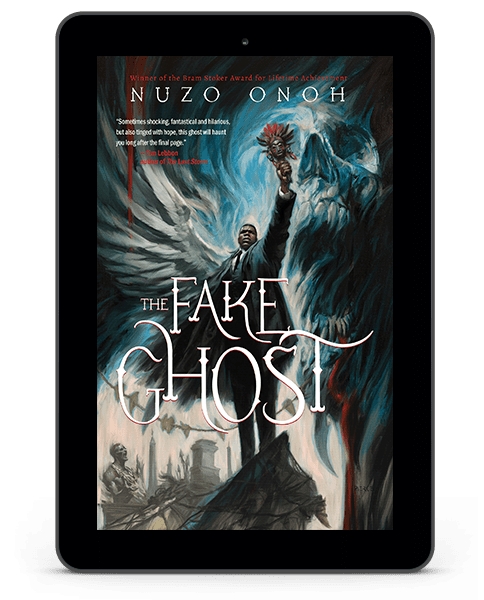
Nuzo Onoh is here to tell us about The Fake Ghost, supernatural horror, magical realism.
There's also a great giveaway.
_____________________
A supernatural thriller of vengeance and occultic magic.
A powerful American leader is reborn as a black child in an
African hut.
The Fake Ghost
by Nuzo Onoh
Genre: Supernatural Horror, Magical Realism
A dark farce and a
supernatural thriller of rebirth, betrayal, vengeance, occultic magic,
mysterious invocations and creepy rituals–from Nuzo Onoh, recipient of the Bram
Stoker Award for Lifetime Achievement and “the Queen of African Horror.”
Set both in Nigeria and the USA, The Fake Ghost follows
the whacky and sinister travails of the President of the United States, reborn
as a black child in a tiny African hut. As the child grows, he insists on being
called POTUS and hears disturbing voices in his head that often cause him to be
cruel and selfish. Until one day an accident separates the linked souls. With
the help of a medicine-man, the president must find a way to free his trapped
soul and return to the United States to prevent a dastardly political plot
against him. But first, he must enter a diabolical blood pact, which might
return to haunt him with devastating consequences.
"Sometimes shocking, fantastical and hilarious, but
also tinged with hope, this ghost will haunt you long after the final
page." —Tim Lebbon, author of The Last Storm
Nuzo Onoh is an award-winning Nigerian-British writer of
speculative fiction She is a pioneer of the African horror literary genre.
Hailed as the “Queen of African Horror”, Nuzo’s writing showcases both the
beautiful and horrific in the African culture within fictitious narratives.
Nuzo’s works have featured in numerous magazines, podcasts and anthologies, as
well as in academic studies. She has given talks and lectures about African
Horror, including at the prestigious Miskatonic Institute of Horror Studies,
London. She is a Bram Stoker Lifetime Achievement Award recipient. Nuzo holds a
Law degree and Masters degree in Writing, both from Warwick University,
England. She is a certified Civil Funeral Celebrant, licensed to conduct
non-religious burial services. An avid musician with an addiction to JungYup
and K-indie, Nuzo plays both the guitar and piano, and holds an NVQ in Digital
Music Production. She resides in the West Midlands, United Kingdom.
C.D. Damitio is here to tell us about The Keys to the Riad, a metaphysical magical realism romance.
There's also a great giveaway.
_______________________
Will the keys to the riad be the key to her happiness?
Or
will they open up the door to ruin?
The Keys to the Riad
by C.D. Damitio
Genre: Metaphysical, Magical Realism, Romance
Colette, the quintessential New York 'it-girl,' has a life
many envy. But as her 40th birthday nears, she feels an undeniable void.
Seeking a unique gift, she discovers a set of ancient North African keys—but
what she doesn't know is that the keys come with ownership of an ancient
mansion steeped in magic, historical intrigue, and family feuds.
Set against the vibrant backdrop of modern Africa, Colette
embarks on an unexpected journey that takes her far from the familiar streets
of New York. As she unlocks each door of the riad mansion, she delves deeper
into its hidden passages and whispered legends, revealing stories of love,
betrayal, and long-buried secrets. Each room holds a puzzle that Colette must
piece together, not only to understand the riad's mysterious past but to find
her true self.
The riad is not without its dangers. As Colette unravels the
mysteries that lie within, she encounters a tapestry of characters—some seeking
to help, others intent on keeping the riad's secrets hidden at any cost.
Will the keys to the riad be the key to her happiness? Or
will they open up the door to ruin?
Tapping
into his eclectic adventures exploring the physical world, mystical philosophy,
and other planes of experience, CD Damitio weaves tales spanning the spectrum
of life. Like the storytellers of old, his narratives transport readers into
diverse landscapes of the imagination.