Malcolm Havard is here to tell us about his historical thriller The Adler Legacy.
Read on for details...
_____________________
Historical Thriller
Date Published: November 17, 2026
A hidden Nazi fortune. A disgraced Bletchley clerk. A mission no trained
agent could survive.
In the ruins of post-war Europe, Sophie Faulkner only wants the past to leave
her alone.
Once a gifted German-speaking clerk at Bletchley Park, Sophie’s life was
destroyed when British intelligence uncovered the truth she had tried to bury:
she was born Sophie von Adler, daughter of a wealthy Nazi industrialist.
Interrogated, imprisoned, disgraced, and abandoned, she has survived the war
with nothing but a ruined reputation and a talent for keeping secrets.
Then MI5 offers her a way back.
Her father’s hidden fortune lies in a Zurich bank account —
millions in Swiss francs and bearer bonds intended to finance the escape of
senior Nazis fleeing Allied justice. To reach it, Sophie must become the woman
Europe’s most dangerous men expect to see: the cold, entitled heiress of
a dead Reich loyalist.
But the money is only bait.
Drawn into a shadow war between British intelligence, American pragmatists,
Vatican fixers, Swiss bankers, Soviet agents, and the remnants of the SS,
Sophie finds herself trapped inside the very network she was sent to expose.
Every alliance is temporary. Every identity is a weapon. And if the men around
her discover where her loyalties truly lie, she will not live long enough to
choose her own future.
About the Author
Award-winning historical fiction from the World Wars to the Cold War.
Malcolm has spent a lifetime gathering stories, living and working in
Australia and the Middle East before returning to the UK. Today, he weaves
that global experience into gripping historical novels that explore the
intersection of crime, war, and espionage.
The Manchester Noir Series: Gritty 1990s crime with a unique twist (The Honey
Talker, The Fatal Formula).
The Aviation Collection: High-octane tales of courage and dogfights in WWI
and WWII (LMF, The Way Back, Leviathan).
The Lisbon Series : Follow ex-cop Dinis Lopes through the treacherous,
"neutral" streets of 1940s Portugal.
Cold War Espionage: Revisit the 1950s with the fast-paced adventures of
Contrail and Czechmate.
When he isn’t uncovering the secrets of the 20th century, Malcolm lives
and writes in Cheshire, England.
J.E. Rizzo is here to tell you about Uprising, Fitzjohn Duology #1, historical.
There's also a great giveaway.
____________________
Uprising
J.E. Rizzo
(Fitzjohn Duology, #1)
Publication date: September 1st 2026
Genres: Adult, Historical
England, 1381 AD: Blanche Fitzjohn is an outcast in her small coastal village. Not only is she the illegitimate daughter of John of Gaunt, the man responsible for her neighbors’ over-taxation, but she possesses strange abilities: hearing sound from miles away and smelling people’s emotions.
She takes solace in her studies with the local wisewoman and in her friendship with Geoff, a groom at the local manor. Until the day Henry of Lancaster, Blanche’s half-brother, brings her news of an arranged marriage to Sir Thomas Prescott, Constable of the Tower of London. Although she smells cruelty on him, Blanche agrees to marry Thomas in the hopes that her influence may help better the lives of Geoff and all England’s villeins.
But soon, the peasants’ discontent turns to revolt. Though her heart is of the people, Blanche’s nobility makes her an enemy to the rebels. To save herself and Henry from the executioner’s ax, Blanche must use every power at her disposal, even those she once considered a curse.
Something shifts, like summer’s green leaves transforming to autumnal gold. Speaking with Geoff about my marriage hurts like I’d never expected, a deep ache. The moon thrums, and an owl, perched in a nearby tree, shifts as she searches for prey. My temples throb.
“It seemed…” he begins again. “It seemed he didn’t want to marry you, after you…” I glare and cross my arms before lifting my face. He continues: “I thought perhaps you could get out of it because…”
“Because of what?”
“Because, ye’re…”
“What, Geoff, what am I?”
His mouth opens like a fish above water, and he doesn’t bother to shut it. In the tree, the owl flaps her wings and leaps into the air.
“Ye’re…” The tips of Geoff’s fingers flutter. “Well, I don’t know what you are, Dandy. Ye’re just…yerself. And I thought—”
“You thought he wouldn’t want me?”
His face falls. “He’s not like you, Dandy. That’s all. He’s not a good man. I heard him talking, when it was just the men…”
He drops his eyes and his cheekbones redden.
Neither of us seems to know what to say next. After a full minute of silence, he lurches forward and grasps my shoulders, crushing me to his chest. “Blanche, just consider.”
I gasp and have to steady myself. But within seconds, tears come to my eyes, along with a calming release of tension. I grip his forearms, inhale his familiar scent. He’s always smelled of horses, with a hint of bread dough and sugar from the manor kitchens he’s constantly raiding. There’s something different tonight. I sniff. It’s crisp, yet soft. Evergreens in winter, covered with fresh snow.
He buries his nose in my hair. “You could refuse,” he says, voice a gentle rumble against my face, “and stay with yer mother. She’d be angry, yes, but she wouldn’t throw you out. They can’t drag you to the church. For a marriage to be real, you must consent.”
Consent. The word ripples through me. It makes me see that I want more, from Maman, from my father, but most of all from Geoff. I need something I can’t identify, something I can’t express.
“If I marry Thomas…” My muffled voice breaks. “It will make the duke happy. He’ll…” I tense, regretting my words.
“He’ll what?”
I can’t answer, can’t tell him that by marrying Sir Thomas, I hope to earn my father’s love. To replace…something.
The moon moves behind a cloud and the trees shift, branches releasing a shower of rain. Geoff drops one hand to the small of my back and lifts the other to my cheek. His palms are warm, and I slide my own to clench his upper arms. When my fingertips brush hardened muscles, I almost snatch my hands back. Before tonight, I still thought of Geoff as a child, the lanky villein who could ride any horse, no matter how fierce. Now…my mouth goes dry, but I can’t resist running my hands up the length of his arms, letting them rest on his shoulders. The skin beneath his tunic is damp with sweat.
Corded muscles tense and stretch beneath my fingers, sending little jolts through me. He stoops, chin brushing my temple.
I touch the notch of his throat with my fingertips. He freezes. Tiny curls of dark hair peek above his collar, tickling my fingers. He lets his face linger on mine, and I feel him inhale.
A pleasant warmth spreads through my belly, then down. Something’s happening, something I don’t understand. I should run, should leave. But I don’t. Another breeze drifts through the tree branches, and he pulls me closer, pressing me to him.
I feel him, all of him, from feet to chin, in a way I never have. A tingling, heavy warmth settles on me, and I feel Geoff’s own need pressing against my belly.
It should make me uncomfortable, but I find myself pressing back, wanting more. Wanting it all.
I’m not well-versed in what happens between a woman and a man—that’s one area of my education Maman neglected—but I’m not completely ignorant. I know Geoff and I stand on a cliff, gazing into a deep ravine. One more step, and we’ll both be lost.
I’m still touching his throat, suspended in our odd dance beneath the shuddering tree branches, when he bends further. I close my eyes and focus on the sensation of his stubbly chin against my face. He exhales, and a shiver runs down my spine.
“Dandy…” he murmurs.
The owl swoops to snatch a mouse from the forest floor in sharp talons. Her screech is like a battle horn, ricocheting with painful deliberation in my skull, joined by the mouse’s squeal. My eyelids snap open and I step out of his embrace.
Author Bio:
J.E. Rizzo is a life-long history fanatic and writer of historical fiction whose work can be found in Vanity Fair, The Boston Globe, The Guardian, The Tudor Times, Tudor Life Magazine, Scary Mommy, and Ultrarunning Magazine. Additionally, her article, Past and Precedence: Abortion Law in the Middle Ages and Its Use to Overturn Roe v. Wade, won History Inquiry’s Medieval History Writing Challenge. Rizzo’s debut novel, Uprising, Book One of the Fitzjohn Duology, is forthcoming from Literary Wanderlust, and tells the story of Blanche Fitzjohn, a fourteenth century neurodivergent woman whose perceived disabilities become superpowers during England’s peasant uprising of 1381.
By day, Rizzo works in Human Resources—a field offering more than ample opportunity to observe the follies and fancies of humankind. Before her career in HR, Rizzo worked as an opera singer, a professional baker, and a dog walker. These days, when not writing she can be found running ultramarathons through the forests and mountains of New England, knitting, reading, sewing, baking, or performing any number of (what some might call) old-lady hobbies. She also keeps busing caring for her two children and forty-seven houseplants, making her husband carry heavy things and cook her gourmet meals, and rehabilitating her rescue dog and semi-feral ginger cat.
Nichole Louise is here to tell us about A Strange & Terrible Wonder, historical.
There's also a great giveaway.
_____________________
A Strange & Terrible Wonder
Nichole Louise
Publication date: August 18th 2026
Genres: Adult, Historical
Eleanor Dare, daughter of Roanoke’s Governor John White, has no choice but to accompany her overly ambitious husband Ananias and her idealist, yet inexperienced father to England’s new colony. Manteo of Croatoan wants nothing more than to cast off his association with the English and return home. Haunted by memories of an unexplainable event, he sets out to find the truth about what was brought to Roanoke by the English two years before as a weapon against the Spanish.
Based on real people who vanished from history, Eleanor and Manteo form a taboo friendship as they work against unseen forces to end the violent and otherworldly attacks upon the settlement. In the midst of this survival scenario, both Eleanor and Manteo—once powerless and marginalized in England, emerge as unlikely leaders of the ravaged colony.
Blending 16th century science, occult, and the impacts of early colonialism, A Strange and Terrible Wonder reimagines what became of the Lost Colony.
“All down the church in midst of fire, the hellish monster flew, and passing onward to the quire, he many people slew.”
– Rev. Abraham Fleming, 1577
August 4, 1577
Bungay, England
At first, the congregants believe the slight rattling is only wind insisting upon the church door. A sudden summer tempest. Rain begins to patter above the nave, the sound not altogether unpleasant—soothing, even. A woman closes her eyes and exhales the stress of the morning as she focuses on the rhythm. Her peace is soon jilted by the growing tempest above, for the rain is now a wonderful force with no less violence than abundance. Her eyes snap open and roll to the vaulted ceiling. The great, forceful torrent empties above in what she imagines as glassy sheets pouring from the eaves. A low grumble of thunder. A child presses close to his mother. The two men kneeling at the altar do not flinch in their prayer; one for an abundant harvest season to pay his debts and another for a wife ailing in childbed.
Lightning flashes in brilliant brightness through the clouded, stretching windows. Silhouettes are carved out of the pews. A gust through the crack beneath the front door snuffs out the altar candles as if the tempest is compelling the congregants to sleep. They are all at once aware of the palpable darkness, so much so that one person cannot perceive another. The only light discerned by the congregants is not from the god hanging above them, but from the intermittent great flashing of fiery bolts.
The roar of the storm is so powerful now that the congregants shift with discomfort. A chill tightens the base of their spines as sweat springs on brows with each fearful heartbeat. The men kneeling in prayer do not relinquish their positions, though they see little, and their knees begin to ache against the flagstones. Instead, they press their eyes and hands tighter and pray now for the light to return. The only answer they receive is a terrible crack of thunder with such force and might that the congregants begin to believe doomsday has come.
The doors are thrown open as if by a blast of gunpowder. Lashing wind explodes down the nave, spraying hot rain onto the necks and backs of the congregants who dare not turn from the cross. The woman who had before held a moment of peace, presuming a gentle patter could not turn tempest, winces at the scalding sensation of boiling water against her bare skin. The church seems to quake and stagger as the scent of glowing iron, not unlike a blacksmith’s shop, permeates the darkened church.
The child clutches tightly to his mother when, amid twin lightning strikes, a great shape dashes down the nave toward the altar. The drops of rainwater on the flagstones sizzle as the thing passes in a hot rush of a blacksmith’s bellows. And with another flash of fire, the child sees it—they all see it: a great black dog with one ember glowing eye running with incredible haste. The woman muffles her scream as others bend beneath the flimsy pews as if a mere board of wood will save them from this devil.
The praying men feel great heat against their backs as if a bonfire has been lit before the altar. A sacrifice. Liquid fear runs down their legs, and still they dare not open their eyes nor pry their rigid hands apart. In another crack of thunder and lightning, the great black dog wrings both men’s necks backward in one clean instant. Its movement is so violent, so swift, that the dead men still kneel in prayer.
The child gasps when the lightning illuminates the whites of dead eyes in the heads bent unnaturally back. He buries his face in his mother’s skirts as her nails dig into his narrow shoulders. The beast turns on the congregation, its low growl indistinguishable from thunder, like a thousand carts moving across cobblestones. It stalks down the aisle, its bellows as hot as the summer sun’s rays. The congregants close their eyes against the darkness, press their slick palms together, and pray for their god to save them in his very house.
The beast chooses a man who dares glance up, for he believes he can slip out the door and escape this hell. Instead, the beast’s shining obsidian claws grip the man’s back in so forceful a manner that it is as if his entire body becomes drawn together and shrunk, as if it were a piece of leather scorched by hot fire. Wordless, he topples over with limbs trailing smoke.
The beast shifts into shadow, and the woman sitting next to the burned but still living man stumbles away from the charred flesh and wheezes for help. The rector, who has finally slid out of the shadows, catches her as she falls from the pew. He prays over her—whispering first, then increasing to test the roar around them. He exhorts the terrified congregants to prayer, and in their extreme distress, do so in darkness. The hot wind and scalding rain lash them, for the tempest has now fully invaded their sanctuary. Some congregants are frozen in terror, save their lips flapping desperate prayers, while others try in vain to crawl for the door.
In a flash, the beast materializes on the main beam above the congregants. Its searing talons set the old oak to smoldering as if coaxing a fire. Its ragged back chars the angel carved into the ceiling. The demon swings down through the church. Three lightning bolts follow the dog jumping from one man to another, then a lad, killing all three instantly. The dog dashes from the crumpled boy, and a deafening crack as if the earth has split in two cleaves the roof, and with it, the steeple. The cascade of stone rumbles down the side of the church, and for one striking moment of terror, a woman cries out that hell has opened to swallow the church whole.
The dog bounds for the next man. He dives away, yet not before his hand is burned by the scalding creature’s touch. In shock, the man lifts his charred hand to the burning sensation where his ear used to be. The creature blasts through the church doors, leaving a trail of scorch marks in the wood. The mischief thus wrought, the beast flies with wonderful force out of the churchyard in a hideous and hellish likeness.
Like a decimated forest in the aftermath of a windstorm, the congregants are left quivering. It’s clear to the man with the burned hand and missing ear that there are forces at work mightier than God, who could not protect his devout followers in His own house. Dazed, the man staggers out of the ruins with his compatriots. He looks to the rapidly clearing sky and resolves to find someone with knowledge of these unseen forces—and how to master them. A conjurer with the influence to pursue the arcane unhindered. What other reason could there be for such hell if not as a path to Providence for England? He will accept no other explanation.
Author Bio:
Nichole Louise is a speculative historical fiction writer and book reviewer (NicholeLouise.com). Raven Rock (2023), a prequel to The Legend of Sleepy Hollow, was recognized by Writer’s Digest, the Historical Fiction Company, and the CIBAs. Her articles and book reviews have appeared in the Journal of the American Revolution. Her second title, A Strange and Terrible Wonder (2026) is a historical folk horror tale exploring the Lost Colony of Roanoke. When she’s not writing, she enjoys reading, gaming, and volunteering at Philadelphia Animal Welfare Society.
Inspired by a mad vision of the philosopher Friedrich Nietzsche, a centuries-old time war is being fought to determine the destiny of the human race. As the conflict rages between the early 18th century and the battlefields of World War I, Czarina Sorceress Catherine Romanova joins forces with her younger self, Princess Von Anhalt, magician Zolo Bold, and World Maker Niccolo Paganini, to face a gamut of powerful and implacable foes. The most dangerous and ruthlessly brilliant of them all, the immortal E. G. Godfellow–once known to ancient Greece as the “Scourge of the Gods”–intends to stop Catherine and her allies from rewriting the history of the 20th century.
Their bold plan, to prevent the 80 million deaths of WW II and inaugurate a new utopian vision for humankind in the 21st century, interferes with Godfellow’s plan to maintain the status quo and thereby usher in his own utopian vision of “One Earth—One Master.” Only one vision will dominate, and either way, the cost will be terrible.
AS SHE KNELT AT THE CATHEDRAL ALTAR in the year 1762 for her royal coronation as Czarina of All the Russias, Catherine Romanova felt like starting a new war. She’d already endured two hours of a five-hour ceremony while wearing twenty pounds of silk and nine pounds of Imperial Crown; and to increase the burden even further, the droning excess of pomp and boredom had drained her of patience, not to mention goodness.
Wishing to distract herself from the seemingly endless prattle of the Russian Orthodox Patriarch as he recited Old Testament scripture, as well as the oven of suffocating heat created by a hoop dress big enough to hide twenty dwarves, Catherine lifted the curtain on theater. She replayed to herself Earth’s most important war to date—the ultimate conflict to define the fate of human nature itself. Her old violin-playing mentor, Niccolo Paganini, had dubbed it “The Utopia War.”
While the aged Patriarch stumbled over a droll reading of Malachi, her musing inevitably took her back to the time just before the war, to another world at age fifteen when she lived in the Castle Bärenthoren and had been known to all of Europe as the famous and unruly Princess Fredericke von Anhalt (aka “Freddie”)—the name born by her proudly until her terribly boring coronation now underway.
Dear God, help me survive this day. My destiny is Catherine, but my soul is Fredericke.
Even though her every breath and eye blink was being carefully watched and measured by the gaseous Moscow nobles who filled the pews of Assumption Cathedral, her first memory began with a sound. A barely audible titter, like distant footsteps on decayed leaves. She’d considered the scraping sound of a mouse to be the origin, or some other invading creature, for every now and then a cat bird or a dove flew into the study and fell to the floor, finally tiring itself out with fearful flutters.
So truly, it could have been any number of things.
Nonetheless, Freddie vowed to ignore the disturbance and return to her prior task: recreating the Greek mathematics of Eratosthenes to determine Earth’s circumference while imagining herself the gallant Sir Francis Drake sailing the Azores in search of Spanish gold.
Putting quill to paper, she sketched the hull of Drake’s ship, The Golden Hind, before jotting down a few notes on the logic of Eratosthenes, and just as she measured the miles between the two cities in his equation, Syene and Alexandria, the strange tittering repeated. But louder this time. Enough to make her hand slip, the point of quill jaggedly defacing her work.
What in Beelzebub’s name? she asked herself.
The disturbance had become too curious to allow any further progress on the circumference of Earth, and though Freddie hated breaking personal vows, she rose from her writing desk, determined to learn the truth.
Author Bio:
Warwick Gleeson has lived in both LA, NYC, and D.C. He has worked many different jobs, everything from brick mason to Federal bureaucrat to small business owner. His agent is currently shopping a futuristic thriller to New York, and a screenplay or two are making the Hollywood rounds. His short fiction and poetry has appeared in many journals such as North American Review, Conjunctions, and Quarterly West. He has two grown children in their forties and is married to a most wonderful woman who is an author of historical murder mysteries and a former writer for National Lampoon magazine.
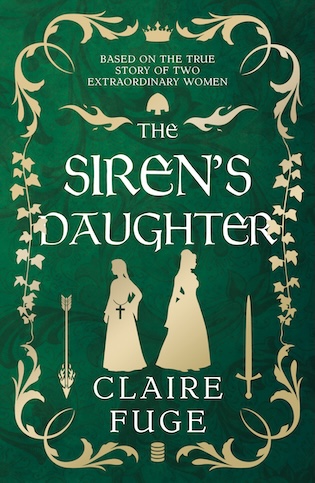
Claire Fuge is here to tell us about The Siren's Daughter, historical.
There's also a great giveaway.
_____________________
The Siren’s Daughter
Claire Fuge
Publication date: June 28th 2026
Genres: Historical
1126. The Norman conquest grips Wales. Rebellion stirs. And one woman’s choice could ignite it all.
Nineteen-year-old Angharad, the daughter of a Norman knight and a captive Welsh princess, arrives at Aberteifi Castle for her mother’s arranged marriage. But her new stepfather, the merciless Norman commander of the castle, has other plans. He demands that Angharad expose her mother, Nesta, as a secret rebel or be cast out to die.
To survive, Angharad presses Nesta to reveal the truth about her past: as a Welsh princess stolen by invaders, the victim of wars and betrayals, the seductress of kings and princes. As Nesta’s story unfolds, Angharad discovers a legacy more dangerous than she could have imagined, and must decide whether to protect her mother or herself…
In 1066, Duke Guillaume of Normandy, known to the English as William the Conqueror, won the Battle of Hastings and was crowned King of England.
In 1087, the Norman barons began their invasion of Wales.
By 1126, after countless deaths amongst the thorn-infested hills, swamps, and forests, the Normans had managed to subdue all five Welsh kingdoms. More or less.
Chapter 1. HOMECOMING
All Hallows’ Eve, 1126. West Wales
When the castle loomed out of the hailstorm above her, Angharad was careful not to crane her head upwards in awe as her Norman guards did. Her mother had commanded her to uphold her dignity, no matter what, so she kept her back straight and sat rigid in her saddle. Although the steepness of the hill made her feel as if spikes of ice were being hurled down at her by the castle itself, she didn’t cower. She pretended not to hear the guards cursing about having to drag a pair of heathen women out of the Welsh wildlands. She alone would be her mother’s last, unfailing support.
Angharad’s mother, Nesta, rode alongside, her imperious glare fixed on the track ahead, ignoring the water that streamed from her claw-black hair onto her horse’s flank. Even dressed in threadbare travelling clothes, Nesta didn’t look like the prisoner she was, finally recaptured by the Normans after three years of threats, bribes, and attempted ambushes. She didn’t look like a new bride either, although she was bound to marry the Constable of the castle; the contract had been sealed. No. What Nesta looked like, in the arrogant line of her jaw, in the resolute set of her flawless face, was what she was born to be.
Royalty.
During her nineteen years of life, Angharad had been reminded daily that her mother was the last living princess of Deheubarth, once the most renowned of the Welsh kingdoms. Angharad’s bloodline was the only wealth she possessed; she must look the part.
‘Amongst wolves,’ Nesta had said – and many wolves lived in the cloud-draped forests of these lands – ‘you can tell the leader of the pack from the way he draws every eye towards him. My father looked like a king from two arrowshots away, even when he was wounded from the endless wars, even when he was starving and freezing and caked in mud. Whatever fate we meet in this castle, I refuse to grovel before them. Hold your head high, Angharad. We must not disgrace the memory of our glorious ancestors.’
Luckily, deception was one of Angharad’s talents: Nesta had trained her in it since she was a child. Angharad had the skill of appearing haughty whilst at her most powerless.
When Nesta dismounted on the crest of the hill, Angharad copied, stifling a wince at the cramp in her thighs. Sixty miles they had travelled from the open meadows where they had spent their years of sanctuary amongst the Welsh: a journey of three days and nights, riding and walking through a wasteland of swamps and brambles, the Norman guards watchful behind them, bloodhounds running at their flanks to warn them of rebels and outlaws, with every hamlet full of hostile eyes and nothing to buy and almost nothing to steal. But here they were, at last.
Author Bio:
Claire Fuge writes historical fiction inspired by medieval Wales, the Tewdwr family and the women whose lives were shaped by conquest, loyalty and survival. Her work explores the spaces where history leaves silence, and where storytelling can bring forgotten voices back to life.
R. K. Harrington is here to tell us about Kindred Schemes, Schemes book 1, historical regency romance.
There's also a great giveaway.
____________________
One bookish
debutante.
Two dashing suitors.
And a season full of scandal.
Kindred Schemes
Schemes Book 1
by R. K. Harrington
Genre: Historical Regency Romance
One bookish
debutante. Two dashing suitors. And a season full of scandal.
Lady Alaina Sinclair never expected London society to be so treacherous—or so
tempting. She has always preferred books to ballrooms, but with a disastrous
start to her first season, she’s determined to rewrite her fate. With her heart
set on the respectable—and very eligible—Duke of Ashford, Alaina is ready to
embrace society’s expectations… even if it means silencing her true desires.
Alaina’s world is set awry by Christopher Kendall, the Marquess of
Rochester—sharp-tongued, maddeningly handsome, and inconveniently, the duke’s
closest friend. Their first encounter is a disaster. Their next, a temptation.
And every moment together after that, increasingly impossible to ignore. But with
a web of secrets, jealous relatives, and mysterious threats unraveling around
her, it soon becomes clear: this is no ordinary season.
Kindred Schemes is a modern take on a regency romance with glamour,
a steamy love triangle, and enough mystery to keep readers turning the page.
What readers
are saying:
"The story’s central love triangle will delight
romance fans...Harrington excels in crafting multidimensional characters...[A]
satisfying blend of romance, intrigue, and character-driven
storytelling." — Booklife
An entertaining period love story, nicely balancing
breathless lust with social satire and high-mindedness.” — Kirkus Reviews
"The characters are colorful and sharply etched…the
prose has a droll, Austen-esque verve to it, using pompously polite palaver to
reveal the crassness of high society...In keeping with the style is the spirit
of the book’s message—that true love triumphs over mercenary calculation.
Readers will root for the feisty Alaina to overcome the stuffed shirts and find
her heart’s desire.” — Kirkus Reviews
Oh no, here he comes, the lascivious Lord Finch and his merry band of
drunken fools. Alaina looked out at the crowded ballroom, her
eyes connecting with the group of men making their way toward its center.
Alaina had only been at the ball for a quarter hour before this particular
disaster struck, the leers of the men making the hairs at the nape of her neck
prickle. It did not escape Alaina’s attention that Lady Barbara, Lord Finch’s
sister, accompanied the group, and wore a sly smile. Hopefully, this latest
encounter would be short. Surely, Lord Finch would not want to be rejected twice,
let alone in front of a large crowd.
Alaina
looked to her right to find her parents close at hand, thankfully, and she
stood a little straighter knowing she would not face this alone.
The
group of men seemed to move in unison before coming to a halt a few paces
before Alaina and her family. A group of onlookers formed a circle around them
as if ready to enjoy the ensuing spectacle, Lady Barbara taking her place in
the throng. Alaina struggled to focus on the faces of the onlookers as she held
her head high, ready to meet Lord Finch and his friends with as much dignity as
she could muster. She hoped to project a more serene exterior than she
currently felt, her heartbeat accelerating to such a degree that she could feel
the blood rushing in her ears.
Lord
Finch stepped to the fore of the now halted group, and gallantly bowed to
Alaina before speaking, his voice so loud that Alaina was sure people arriving
in carriages outside could hear.
“My
dearest beautiful Alaina,” he started, clearing his throat before
continuing, “You have set upon me quite a conundrum. I fear I have fallen madly
in love with the idea of having you as my wife, and I feel you should be happy
with such an arrangement. I am quite the catch, you know, especially for
someone from the country, and one who likes to read.”
From
behind him, Lady Barbara piped up with an added insult, “Amazing, really, that
Alaina found her way out of the library to be here.” Laughter rippled through
the crowd.
Alaina
cringed at his easy use of her given name, devoid of any honorific, and seethed
at the mockery of her character. Lord Finch and his sister sounded ridiculous,
pompous, and conceited.
Alaina
was frozen in place, her lips trembling in rage, and when no comment ushered
forth from her lips, Lord Finch rejoined, unfazed by the one-sided nature of
their conversation. “I find myself at an impasse. Shall I continue to press my
suit with decorum, or should I make my feelings known to the whole world, so
that you may not so easily dismiss them as you have in the past?”
A
warmth crept up Alaina’s neck and touched her cheeks, giving her pale skin a
glow, although one not easily perceptible in the dim light of the ballroom. She
turned once again to where her parents stood, only to find that her father had
disappeared, and her mother’s pale face was drawn in embarrassment as she
watched her eldest child with dismay. Oh, how Alaina wished her father would
have stayed; his tall frame was intimidating to a crowd, and his familiar umber
eyes were always reassuring to her.
Resolved
to put a stop to this farce, Alaina turned back to Lord Finch and remarked, her
voice distant and strange sounding in her ears, “Lord Finch, it seems my
earlier rejection of your suit did not deter you in the least, but I ask you to
have a care for your surroundings.”
As
the words left her mouth, Alaina watched Lord Finch’s face change, his
outwardly serene expression making way for something more sinister. His smile
twisted into an outright leer, and his pale green eyes seemed to burn of their
own accord, the candlelight no longer just a reflection in them. He lowered to
one knee and reached out his hands in supplication as he sneered, “Please, will
you marry me, my lady?” The emphasis on the last word ensured that
Alaina felt the insult.
Lord
Finch was quickly joined by his friends, their idiocy knowing no bounds, all of
them dropping to their knees in a chorus of marriage proposals, each more
mocking and infuriating than the last. Soon laughter rang loudly in Alaina’s
ears as the men and then the onlookers seemed to find amusement in her
predicament. Her world blurred through a sheen of tears, the faces of the
laughing men—now resembling something like demons—the only clear points in her
vision.
Alaina
glanced about to find her mother and threw herself into her open arms,
shielding her from the worst of the crowd. The two women made their way to the
outer edge of the ballroom and quickly to the front entrance, only stopping a
moment to gather their cloaks before heading out into the cool night. Her
father, having had the forethought to make his way to the exit, met them in the
front drive, where he had already called for their carriage to be brought
around, and not a moment too soon.
The
Sinclair family hastened into the carriage, a pall falling on them as the
conveyance made its way onto the main thoroughfare and toward their London
townhome. Alaina squeezed her eyes shut, focusing on the clip clop of the
well-matched team of four, grateful for the silence of her parents, as she let
tears make their way unchecked down her cheeks.
R. K. Harrington is a debut historical romance author,
combining swoon-worthy romance with a bit of mystery. Her first novel, Kindred
Schemes, is scheduled to be released February 2026.
In 2021, R. K. Harrington found that her daydreams were
yearning to spill over to the written page, and, ever since, has been writing
historical romance with a dash of mystery in hopes of publishing her work one
day. After much editing, and long hours designing, she is gearing up to release
her first novel, with many more to come!
R. K. Harrington grew up reading romance novels at a (maybe
too) young age, and the stories entranced her. Give her a Happily Ever After
(HEA) and there is no better book in the world. While romance books (namely
historical romances) are her first love, R. K. Harrington is an avid reader of
all genres. She has gone through many phases: medical mysteries, crime dramas,
science fiction, romantasy, and is currently in a fantasy phase (she does do
the occasional non-fiction book as well, namely history). Through every season
of reading, romance books of all kinds are sprinkled liberally.
When R. K. Harrington is not writing or reading (or working
her day job as an engineer), she is having fun with her husband, their kids,
and her very cute dog, a Pembroke Welsh Corgi named Maximus. They all live in
the DMV area, where the summers are hot, the winters are cold, and the two days
of Spring and Fall are beautiful enough to open the windows!
James P. Cain is here to tell us about Reign of Secrets, historical fiction thriller.
Read on for details...
____________________
Historical Fiction Thriller
Date Published: 12/10/2025
Publisher: Manhattan Book Group
When the Prince of Denmark is murdered in the Florida Keys, an unlikely
duo of American and Irish diplomats in Copenhagen becomes embroiled in a
deadly game of espionage, ancient conspiracies and high stakes diplomacy as
they confront one of the West's most dangerous enemies. In Reign of Secrets,
Colonel Whit Ransom and Irish attaché Aisling Kelly race across Europe
to stop the Russian President and his assassins as they chase the Danish
Crown’s most guarded treasure, a thousand-year-old secret that could
threaten the royal houses of Europe and return the Russian empire to glory.
In Reign of Secrets, diplomacy meets danger, and the past may be the deadliest
weapon of all.
Praise for Reign of Secrets
"A gripping, timely story... that masterfully blends that warrior ethos with
today's geopolitical reality, as Whit Ransom confronts Vladimir Putin's
ruthless ambition to resurrect an empire."
- Lt. Col. James Reese (Ret.), US Army Delta Force Operator
"Through this historical thriller, Reign of Secrets offers a captivating
glimpse into the essence of what it means to follow in the footsteps of
legends..."
- Morten Andersen, "The Great Dane", Member, NFL Hall of Fame
"A masterfully crafted tale that explores how the West's adversaries subtly
challenge the narratives of history - reshaping symbols, exploiting
weaknesses, reframing legacies, and testing the resilience of democratic
values and the international order."
-Lt. General Ed Cardon (Ret.), former Commander, US Army Cyber Command
About the Author
James P. Cain’s remarkable career has spanned the fields of law,
business, politics, sports and international diplomacy. From volunteering on
Ronald Reagan's first Presidential campaign, being featured on CBS's 60
Minutes at the age of 27, to becoming a partner in an international law firm,
serving as President of the NHL Carolina Hurricanes, and later as U.S.
Ambassador to Denmark, Ambassador Cain has operated at the highest levels of
leadership and public service for over five decades.
A personal encounter with Islamic terrorism in 2016 became the catalyst for
writing Reign of Secrets.
Reign of Secrets is the first in a series of Whit Ransom novels.
His first book, The American, written during the last few months of his
diplomatic service, was a Bestseller in Denmark.
Ambassador Cain and his family live in North Carolina.